




A View of Planet Earth With Summer - Page 2
| Previous | Next | Page 1,3,4,5,6 |
 |
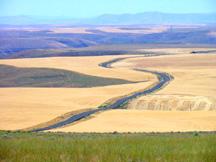 |
From Moro, we continued southeast toward our destination of Fossil, Oregon. On the way, we descended into the beautiful John Day River gorge. The John Day River is the second longest free-flowing river in the continental United States, and at 280 miles, the longest undammed river in the Pacific Northwest. It is federally protected as a wild and scenic river and the scenery is truly spectacular with colorful canyons, broad basins, and impressive basalt formations and palisades that tower over the river more than 3,000 feet in places. This entire river basin is tucked into a portion of central Oregon that is set apart from the busy highways and population centers. It could even be called a desolate area.
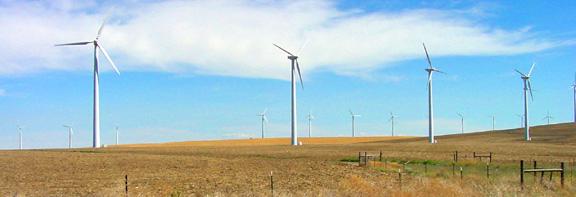
After climbing out of the gorge, we found ourselves on a high plateau with wheat fields as far as you could see, but it was not long before we spotted another windmill farm as we approached Condon, Oregon. The giant windmills were slowly turning in the wind as we passed by. This is the largest wind turbine field in the state of Oregon with about 83 of these massive machines spinning in the air. Here again, Summer learned where electricity comes from.
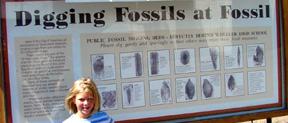 |
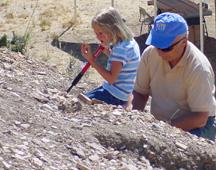
We arrived in Fossil in late afternoon and discovered that there was a very nice RV park at the fairgrounds in town. This would be our home base for the next three days. Fossil is a very small town with a population of about 460 people. It was incorporated in 1891 and it took the name of the Post Office that was founded here in 1876. The Post Office was named Fossil because of Mammoth bones that were found in this area at that time. We think the town was well named because it is within a short driving distance of the three units of the John Day Fossil Beds National Monument, and there is a place behind the high school where the public can dig for fossils. After setting up camp, we arrived at the digging site about 15 minutes before it was to close for the day. We then got instructions about the dig site, where to dig, and what to look for so that we would be prepared for our digging adventure the next morning.
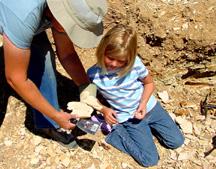
We arrived at the digging site the next morning with our digging tools in hand. Also, the lady who had given us instructions the previous day was already scouting out the dig site and showed Summer some samples of what she had just found. She showed Summer just what to look for and how to separate the rock layers to reveal the hidden treasures.
 |
 |
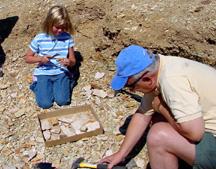 |
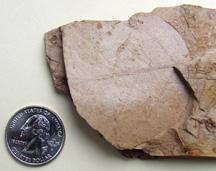
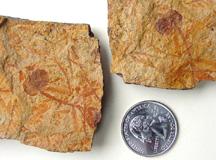
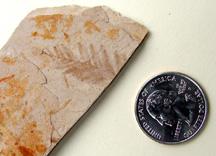
This was a fun experience and Summer was able to find several nice specimens of leaf impressions that were preserved in rock. This particular place has an abundance of fossil plant deposits ranging in age from one million to 32 million years old, and they are part of the "bridge Creek Flora", the general term given to these fossilized plant deposits found in this part of the John Day River basin. Many of these remnants of fossilized flora are distant relatives of similar species found today in regions of Eastern Europe and Asia. We found one good specimen of an Alder leaf and several of Metasequoia. A small group of a closely related species of Metasequoia was recently found in an isolated range in present day China. Besides these specimens, other fossil flora that can be found include Hawthorn, Ash, Walnut, Sumac, Oak, Pine needles, Ferns, extinct fruit, Maple seeds, various nuts, and other unknown and extinct species. All of these were preserved under cataclysmic conditions when volcanoes appeared and erupted huge amounts of ash that then precipitated lahars (huge mud flows) down mountain slopes, which buried the flora under fine silt. Of course, animals also got caught up in the mayhem although their fossils are more difficult to find compared to the fossils of the abundant flora.
 |
 |
 |
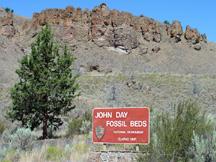
This area of Oregon, where the John Day Fossil Beds National Monument is located, is actually world-renowned among paleontologists. It contains an area of heavily eroded volcanic deposits with a well-preserved and prolific fossil record of both plants and animals that span more than 40 million years of the 65 million years of the Cenozoic Era (the age of mammals and flowering plants). No other region in the world shows a more complete sequence of plant and animal populations of that time period and the monument now protects one of the longest and most continuous records of evolutionary change, biotic relationships, and climatic change in North America. The monument was established in 1975 and includes three widely separated units that include the Sheep Rock Unit, the Painted Hills Unit, and the Clarno Unit.
 |
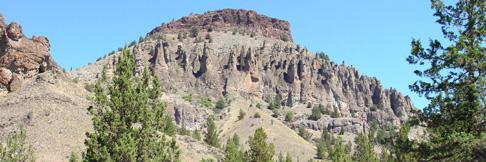 |
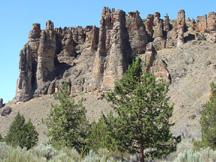
After collecting a box full of fossilized leaves in the town of Fossil, we then decided to head for the Clarno Unit, which is located 18 miles west of town. Here at the Clarno Unit, the cliffs of the Palisades are the most prominent landform and they tower above the hiking trails, the exhibits, and the picnic area. After a picnic lunch, we took to the trails and stopped to read each interpretive sign along the way. It was hot and the vegetation here is typical of central Oregon's near-desert environment with a variety of grasses, sagebrush, and juniper. The Palisade cliffs that towered above were formed 44 million years ago by a series of volcanic lahar mudflows. These lahars captured and preserved a large variety of fossils from an environment that was very different from that of today. At that time, volcanoes loomed over the landscape and were covered by near-tropical forests that received nearly 100 inches of rain per year. The fine ash from the volcanoes that mixed with all the rain on the steep jungle slopes created the perfect conditions for trapping and preserving life forms of that time. The fossilized animal remains included crocodilians, huge rhino-like brontotheres, small three-toed horses, and meat-eating creodonts. It was hard for us to imagine such a place in the near 100 degree dry heat we were experiencing, where rainfall here now ranges from 6 to 19 inches per year.
 |
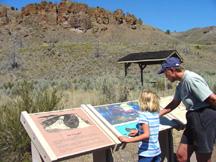 |
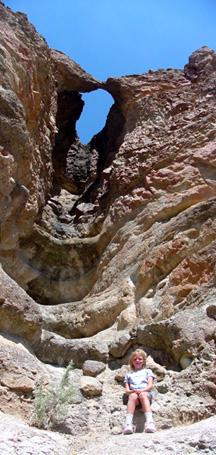
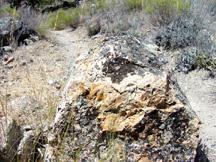
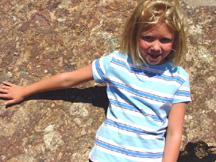
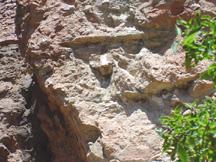
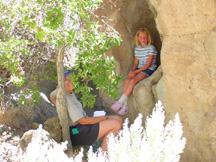
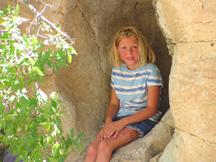
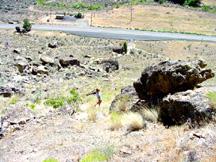
As we hiked the trails, signs pointed out to where we could find the imprint of leaves in rocks and boulders, where we could see fossilized limbs of trees, and where we could see other unique features of fossilized remains. As we continued on, a sign pointed the way to a spur trail that ascended a steep rocky slope to the base of the Palisade cliffs. We debated about continuing on, but Summer was determined that we should head up the hill. We did finally reach the top end of the trail where we were treated to a spectacular vista of the area. And, we could see above us where a fossilized log was sticking out from the cliff, and near it was a natural archway that connected two pinnacles of the Palisades. There was also a bench where we could sit to enjoy the view, and a large rock nearby had a niche where Summer could sit that had a shade tree next to it. It had been worth the hot climb to this spot.
 |
 |
 |
 |
 |
 |
 |
 |
| Top | Next |